
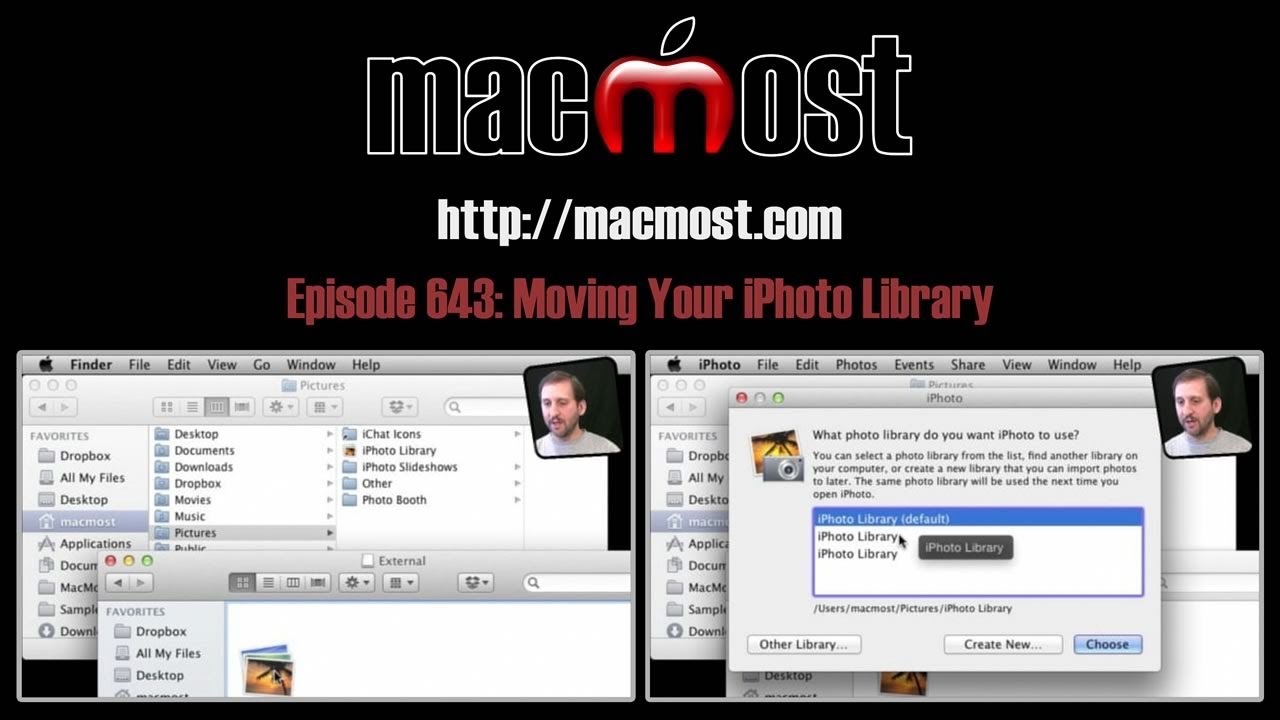
You can move your iPhoto library to an external drive easily by simply dragging the iPhoto library package to another location. But keep in mind that external drives are slower than internal ones, and networked drives even more so. You can also create multiple iPhoto libraries, storing seldom-accessed photos elsewhere.
▶ You can also watch this video at YouTube.
▶
▶ Watch more videos about related subjects: Photos and iPhoto (112 videos).
▶
▶ Watch more videos about related subjects: Photos and iPhoto (112 videos).
Video Transcript
Hi, this is Gary with MacMost Now. On today's episode, let me show you how to move your iPhoto library to another drive, and why you may not want to.
Moving your iPhoto library is not as complex as moving an iTunes library, because you don't have any choices. The iPhoto library is one single file. It's actually a package. You could put that anywhere you want, but it all stays together, so you don't have any choices about putting some things in one place and some things in another.
Let me show you. Here I am in my Home folder, and under my Home folder I have Pictures. There you can see I've got something called iPhoto Library, and this is the default location for your iPhoto library. It's a single file, it's actually a package, and you can look in it if you want but I'm not going to go into that right now. You can move this anywhere you want. You can put it in another folder, and you can move it to another drive. For instance, if I wanted to move it to my external drive - and here I've got one with no files in it at the moment - I can simply copy the entire thing there, and it will copy all the photos, everything associated with that iPhoto library.
Now that that's done, I've got two copies of that library, one in the original location and one in the old one. I can go back to this one later and delete it once I confirm this one is working fine.
Now I'm going to launch iPhoto, but I'm going to hold down the Option key on my keyboard when I do it. What will happen is instead of it just opening as normal, I'm going to get presented with this dialogue box here. Here's where I can select a different iPhoto library. I've got three here: the one that you would normally open, that's the one we took the copy from, and I can look here and see there's another one that is on the external drive, which is the one that I just used, and it's called iPhoto Library. That's the one we want. I'm going to choose that one, and now it's going to open up iPhoto and it's going to have the same pictures I saw before. So I can confirm that everything's okay and I can go through the photos, and once I know this one is fine, I can delete the original, just put it in the trash for now. Then next time I launch iPhoto - I'll quit it and I'll launch it again - it'll know to go to that library, it won't ask me again unless I hold down the Option key.
That's all you need to do to move your entire iPhoto library to an external hard drive. Now, there are things to think about when you're moving it there. One is speed. Typical speed for an internal hard drive inside of a computer, say an iMac, is about 3 gigabits per second. That's a transfer rate to get the files from your hard drive into your computer so you can see them. So, to bring a photo onto the screen. 3 gigabits per second is about 3000 megabits per second. Remember that number, 3000. Now, if you've got a USB 2.0 hard drive hooked up to your computer and you move the photo library there, the transfer rate across that USB cable is only going to be 400 megabits per second. 400 versus 3000. iPhoto isn't the fastest program because it's showing you lots and lots of photos, so you're going to cut that speed considerably in half by about a seventh if you're going to move your library to an external drive. If you have lots of photos and you're used to just scrolling through them fluidly, you may find it doesn't work as well when it's on an external drive.
Even worse, a lot of people try to move their iPhoto library to a network drive. A network drive is going to be much slower, somewhere between 50 and 100 megabits per second compared to the 3000 that you were getting when you had your iPhoto library on your internal drive. Moving to an external USB drive may be okay for you; moving to a network drive probably is not going to work.
A good option is to split up your iPhoto collection. Notice that I could have created a new library in addition to choosing one of those. If you have a ton of photos but you find you really only access the ones from your last trip or from the last year or two, you can create multiple iPhoto libraries. It's hard to work with them, because you have to switch libraries all the time, so if you want to access all your photos it's not a good idea. But, say, if you wanted to create a specific iPhoto library for a specific event or a big trip, or one per year, you could store older ones on an external drive or perhaps on your network, and the current one, the one you're always accessing, on your internal drive where it's nice and fast.
I hope you liked this look at how to move your iPhoto library to another location. Till next time, this is Gary with MacMost Now.


Gary, great video, thanks for addressing the realities of the transfer rate. If I upgrade to Lion, will PhotoStream still sync with iCloud and my iOS devices if iPhoto is on an external drive?
Should, yes. The PhotoStream feature doesn't care about the specific location of your iPhoto library.
Do I do these same steps if I'm moving onto an external just for back-up? I tried to move pics over but they went into thousands of individual pics, rather than my labeled folders. Help :(
If you want to back up your iPhoto collection, you can just drag and drop the iPhoto library package file to another drive, yes. But I would recommend a more complete and robust backup plan, like using Time Machine.
Very informative video. I've been using multiple iPhoto Libraries for several years - all on external HDs, because I had an unfortunate experience with my built-in computer drive a few years ago. Most of these are work-related and are quite large, and I have to switch back and forth quite often. I can't overstress the usefulness of the third party iPhoto Library Manager in doing this, as well as transferring albums from one library to another and generally managing my photo records. It's easily worth the $20 price tag.
Is it possible to have more than one iphoto library, say for different categories of photos, located on the same HD? For example, iphoto library1 and iphoto library2?
Absolutely. I say that in the video.
What is the largest file size an iPhoto library should be before having to creating a new library?
Not completely sure, but I hear it is 250,000 photos. No limit on file size.
I'd imagine that if you are even close to that then you are pretty serious about photography and may want to look at more "pro" solutions like Aperture.
Is there a way to set up iPhoto on my Time Machine so that i can access/manipulate/add to from multiple computers? Share that library so to speak? Thank you in advance for your help! Very helpful videos!
You could put it on a network drive, yes. But it will be slow (I mention that in the video). And you'll have to watch out for cases where more than one machine is trying to access it at the same time. Many disadvantages to doing it that way.
Hi Gary,
After moving my iPhoto library to my NAS, now I want to still work on my local drive iPhoto library, by scaling down its file size, i.e. by specifically deleting the older albums manually one-by-one. However, when I do that, I realized only the albums are deleted and not the pictures. (so the iPhoto library file size remains the same).
May I know a way or short-cut keys to be able to delete the albums and the pictures in it at the same time?
Thanks!
Kelvin
Albums are list playlists in iTunes. The photos aren't there -- they are just links to the photos. Deleting from an album only removes it from the album. So use the Photos or Events listing to delete photos, not the albums.
Option plus command plus delete will delete link from album and also its source. You can also delete photos not in any albums by using album_ _ _ is not any _ _ to create a smart album. This sorts out the ones you thought you had deleted enabling you to get rid of them.
How about a similar video on moving the Aperture Library?
I'd like to use some of the techniques your video and commentators have suggested to split up/move my iPhoto library [currently 198 events/14,000+ images and film clips]. (I am using a FireWire external HD with an transfer rate approaching that of my internal HD to hopefully minimize transfer speed issues)
Considering that iMovie is somewhat dependent on the content of the iPhoto library, what are the implications to iMovie as a result of moving or "remodeling" my iPhoto library?
Firewire, while fast, is still not nearly as fast as an internal drive. Keep that in mind.
I wouldn't say that iMovie is dependent on iPhoto. Sure, it is a nice shortcut to be able to browse and select iPhoto images in iMovie, but you don't have to. You can also drag and drop images from the Finder into iMovie. But if you make a lot of slideshows in iMovie, and you like the iPhoto integration you would just have to switch to the right iPhoto library before working in iMovie.
Hi Gary, Hoping you can help me out. Two questions. First, when I take pictures I shoot with the raw file format. They import to iphoto as raw files, but when I want to open one in photoshop it opens as a JPEG. And when I moved the files to my external hard drive, they all became jpeg files. Not what I wanted. Is there a setting I am missing? Second question: occasionally (more frequently lately), when I download my pictures to iphoto, there are some images that don't get imported and I have a message saying that iphoto could not read the files, although 90% of the same shoot with the same file (NEF) are imported. I don't want to loose those pictures, adn I don't know what to do.
I don't use the RAW file format, so I don't know the answers to your questions. Maybe Photoshop doesn't handle them? Maybe drag-and-drop out of iPhoto converts them to jpeg automatically? And maybe there is a sleigh incompatibility with your camera and iPhoto?
Perhaps a more hard-core photography forum would be the place to ask.
But that also gives me the idea: If you are hard-core enough to use RAW file format, then why use iPhoto? I'd imagine that Aperture would be a better tool. I'm not a Aperture user, so I don't know if it fixes these issues for you.
Hi. I have my iPhoto library on my TIme Capsule and you are correct, it is really slow. I tried to move it by drag and drop to my EPassport (usb 2.0) and it will not let me? Any thoughts?
I would move it to your internal drive. That's the fastest. USB 2 will be faster than wifi, but still slower than the internal bus. What error message were you getting when you tried to drag the library?
Hello. I currently have two iPhoto libraries - one is on my Mac and the other is on my external hard drive.
I am about to add a third library. I would like to rename the iPhoto libraries so that I won't mix them up in the future.
MY DILEMMA: Won't renaming the iPhoto library ruin my iMovie projects? ie Once the iPhoto library is renamed, iMovie will no longer be able to locate the photos used in the projects because the location name has changed.
Is this a legitimate problem? Has anyone renamed his/her iPhoto library after using photos within it to create an iMovie project and had any problems, or should I stop worrying and just do it?
Thank you!
I've never done that, so I don't know. But it can be easy to test. Create a new iPhoto library. Drag a few photos into iPhoto. Create a new iMovie project. Bring in those photos. Quit iMovie. Rename your iPhoto library. Run iMovie again. See what happens. Should take a few minutes, but you'll get your answer.
I have gotten into a lot of trouble renaming and moving iPhoto libraries. Absolutely - iMovie cannot find the source location of the videos or photos. What is more annoying - there is no way to point to the new location. Gary (anyone), is there a way to rename or move an iPhoto library AND update the links in iMovie to the new location?
I still have not found a good solution for moving iPhoto libraries and re-establishing the links to iMovie projects.
My experience is that if a project has not been finalised, and any detail in the iPhoto library location or name changes, the all links are broken and the movie does not even play iPhoto content. If a project is finalised (shared), a permanent copy seems to be made, but yellow warning indicates that the links are broken.
It makes it hard to have iPhoto libraries spread across several disks that really need to be retired.
It's simple really, and existed in iMovie HD - a very easy option to search and reconnect to files, music, photos or videos that had been moved. Please let me know if this is possible?
Perhaps if you often move your photos and photo libraries around then the best way to use photos in iMovie is not to take them from iPhoto at all. Export them from iPhoto first (drag and drop to make it easy) and put any photos you will use into a special folder for your iMovie projects.
Thanks Gary, for the reply. I'm not sure this would have helped, however, nor if it would have been worth the significant effort of the undertaking. Even if I have duplicated every needed file before using it in iMovie (not very handy), I guess I would still face the same problem - not being able to move these files.
I do not want to move libraries a lot, I just want to move them to bigger and faster HDs as they become available. I am planning a new computer, but cannot see a way to consolidate my iPhoto libraries in a single location without all links between iPhoto and iMovie being irreparably broken.
iMovie really isn't made for super long-term projects like that. It is made for putting together a video, producing the video, and then you are done. It doesn't work well for going back to that same project 2 years later to make small changes. It can do it if you set things up right, but you have to put a lot of work into it like I suggest -- or keep everything in the same locations.
Gary,
there are two users on my Mac and I am the administrator. I tried sharing my iPhoto library so the other user can access it but it still shows restricted when in the other account. What can I do? One solution could be to move my whole library to the users shared account but I would rather not do that if it can be avoided.
Check and recent everything. Maybe iPhoto needs to be running, like it does if sharing across machines. I've never tried to use iPhoto sharing to another user account.
Hi, I have my pictures on an external hard drive and ran out of space I want move to another larger drive. Each time I move the thumbnails don't come along with the pictures. Any tips?
Does it generate the thumbnails again OK? If so, don't worry about it.
Good info here. My situation is this: iPhoto library takes up too much space on internal hard drive, so I moved it to external. But now how do I back up the external drive on a regular basis so it just includes the new photo's and not have to drag the entire iPhoto library over each time? In short, what's a good back up plan for iPhoto that lives on an external drive? Thanks!
Just use Time Machine. It should back up all connected drives. Check your settings to make sure it didn't get "excluded" somehow. And then, of course, make sure you have the drive plugged in every once in a while so it gets backed up.
Wow, that makes a ton of sense. I guess I just consider external drives to be different somehow. Thanks so much. That really helps me.
Hi Gary, Will I encounter any problems moving my Iphoto library to the same external hard drive that serves as my Time Machine? Will it back up the library successfully even if it is on the same drive? I am also considering buying the Iphoto Library Manager so I can edit current photos on my Macbook before moving them over to the external hard drive Iphoto library--essentially using the external hard drive for archive purposes and the Macbook for active photos. Am I setting myself up for problems having TimeMachine and an ever-changing Iphoto library on the same external drive? Thanks for your help!
Don't do it. First, moving your iPhoto library to ANY external drive will mean a big slow-down in using iPhoto. External USB drives are slower to access than internal ones, and iPhoto needs fast access so you can browse megs of photos quickly as you would expect.
Second, you should never put anything else on a Time Machine hard drive other than Time Machine. TM must be allowed to manage the drive on its own, otherwise it cannot work properly.
Third, it doesn't make sense to back up anything from one part of a drive to another part of the same drive. The most likely use of a backup is when a drive fails. If that drive were to fail, you would lose both your photos and the backup together.
The best way to do this is to get a larger internal drive. Second best is to get a dedicated photos/archive drive that is separate from your TM one. Then make sure you back that up (to TM or some other way).
Great video, very helpful.
Hi Gary - thanks for this post, very helpful. After moving iPhoto library to an NAS drive I am refused access to open the file with iPhoto. When I double-click the iPhoto icon, it tells me I don't have permission to open this file. Is this an issue with the iPhoto library file or with my rights on the NAS drive?
Thanks -
Sounds like an issue with your NAS. iPhoto should be able to access it. Be interested to hear your experience with this once you get it working. Over a network is much slower than accessing your photos on your internal drive. Much slower. Scrolling up and down through your photos should suffer. So do report back and let us know how it works for you.
You would think someone could sort this out. I have a new WD my book live. It's just taken about 5 hours to copy 768Gb from a seagate black armour NAS to the WD via a gigabit router, which is not bad. Individual movies only take about a minute. Happy with that.
I tried to copy IPhoto - 238Gb from a 1Gb external drive connected to the Mac via USB. The transfer rate was so bad it would take almost a year! I had the bright idea of copying the IPhoto library back to the Mac & then copy to the WD. It took about 2 hours to put the 238Gb back on the Mac.
Now I am watching the library copy to the WD, estimated to take 19 days!! This is crazy. What is the problem??
Hi, Gary! Thank you for the video, but I have tried a couple of times to just simply drag my iphoto library to my Maxtor external drive, but it wouldnt copy. :( It shows something like a blocked icon when I try to drag/copy.. What should I do? Thanks for your help and Id appreciate a reply from you.
Sounds like you either don't have permission to write to that drive, or the drive isn't formatted as a Mac drive. Or, perhaps there isn't enough space.
I have moved several iPhoto libraries to an external drive using the Apple recommended procedure. Works fine. I have another iPhoto library that I would like to move to Trash. Does that sound OK? Would it be advisable to first send its photos to Trash and empty the Trash so as not to corrupt the master database file? Thanks!
An iPhoto library is just a really big file -- a package actually. Throwing the photos in the the trash and then the library itself in the trash would be a waste of time. There is no "master database file" -- each library is its own database.
Gary, your explanation is most helpful. Each library "package" contains database files that keep track of that library's photos. Each of my libraries is independent of all others, so I can trash a library, and that does not affect the others.
Hi Gary,
Great resource here. I just got the iMac for Xmas, so I'm creating an iPhoto library. I recently transferred YEARS of photos from my PC hard drive onto a 3T external, networked hard drive. Is there a way to tell iPhoto to make that drive my iPhoto library, or do I have to import them all into iPhoto on the iMac, then drag them back to the external drive? (After your warning about speed, I plan to create two libraries, keeping the most recent photos on the iMac drive.)
Also, the networked drive was set up for PC. I’m not sure how that effects the answer. The photo thumbnails are visible in the Finder. Thanks for your help!
An iPhoto library is a special file (package) that contains your photos and a database of information about them. It isn't a "drive" or a folder of photos. So if you want to create an iPhoto library, you need to import them into iPhoto.
You can create an iPhoto library on another drive, like your external one, but you would still have to add your photos to it. Not sure if the drive being formatted for PC will make a difference. Maybe.
Hi Gary. First of all let me tell you that you have a wonderful page and videos. I am practically learning to use apple from your page.
I twitted you basically because of my little knowledge of Mac. I have an IMac with two internal Hard Drives. The first one is a SSD of 250Gb. The second one is a 1Tb (normal hard drive). The IMac uses the first one as its startup disk. But it also uses as it default location for the IPhoto library. I do not see the 1Tb drive. How can I move it there. Thanks
If you do not see the 1TB drive, then you have an issue and should get someone to look at it.
Then once you get that working, you can do what I suggest in the video.
Gary, I have had success following your instructions, but unclear if I can reverse the process. I use Time Machine. I want to have one more backup of photos (and iMovie videos) on an external HD. I want to be able to take the iPhoto package which is on the external HD and transfer it to another computer. I have a MBP and MBA. I use the MBP for iPhoto (and iMovie). The MBA has iPhoto installed, but I don't use it. No photos presently. How do I install the library to the MBA?
Just move the package file there. Then hold the Option key down when starting iPhoto to select it.
Hello,
I dragged my iphoto library to an external HD to save them there. Then I moved the iphoto library still on my internal HD to the trash to free up space. Then i went to view the photos on my external HD to make sure they were there, and upon clicking on the external iphoto library folder it brought up iPhoto, loaded the events, and said it was rebuilding thumbnails, but no pictures ever came up. The folders are empty. How do i get my pics back into iPhoto? thanks!
Try it again. Maybe something went wrong. If you still can't get it to work, maybe seek out pro help.
Hi Gary! Great video! I have my iPhoto library on a NAS and yes very true is incredibly sow. The problem I have anyway is that itunes now cannot find the library anymore so I cannot sync any more photos on iPhones etc... When I go into the photos section of the device the option of selecting events and album is greyed out and if i decide to sync the whole library it just says that it could not find it.
Any ideas? Thanks in advance!!
No idea. I have my iPhoto library on another drive and am able to sync as normal.
If I split my library up into smaller libraries, say one per year, do I then delete the photos from the original library?
Sure, if you want to. For most people that would be the point. Just make double sure that you have done the splitting correctly and all photos are accounted for.
Hi Gary,
Hoping you might know how to fix an issue I have. I moved my user profile from my solid state drive to my TB drive (which included my iPhoto library). Everything seems just fine, but if I go to iPhoto and try to export a photo it does nothing. Same thing if I try exporting a file from Preview now.
Nothing? That's odd. Impossible to say what might be wrong. You may need to get it in front of an expert to check it out.