
Get up to speed on macOS Spotlight quickly with this guide. Learn the basics plus a few critical tips to get the most from Spotlight on your Mac.
▶ You can also watch this video at YouTube.
▶
▶ Watch more videos about related subjects: Spotlight (23 videos).
▶
▶ Watch more videos about related subjects: Spotlight (23 videos).
Video Summary
In This Tutorial
Learn how to use Spotlight in macOS to quickly launch apps, search for files, perform actions, access your clipboard history, do calculations and conversions, and customize search results.
Launching Apps With Spotlight (00:38)
- Open Spotlight with Command+Space or the menu bar icon
- Customize shortcuts in System Settings > Keyboard > Keyboard Shortcuts > Spotlight
- Use Command+1 or a custom shortcut to open Apps view
- Start typing the app name and press Return to launch
Searching For Files With Spotlight (01:07)
- Use Universal mode or Command+2 for Files view
- Type a file name or content keyword to find files
- Use tags at the top to filter results by type, like Keynote presentations
Spotlight File Search Tips (01:37)
- Preview files with Quick Look using Spacebar
- Hold Command to see the file path
- Press Return to open or Command+R to reveal in Finder
- Use “/” before a folder name to limit results to that folder
Accessing Special Actions and Shortcuts (02:29)
- Access built-in app actions directly from Spotlight
- Send a message or trigger other actions without opening apps
- Run your own Shortcuts and assign quick keys for faster access
- Search and execute menu items from Spotlight
Access Your Clipboard History (03:18)
- Use the Clipboard mode to see recent copied items
- Click to paste or copy items back to the current clipboard
- All clipboard items are also available through Universal mode
Calculations, Conversions, Info Lookup and More (04:01)
- Perform basic and complex calculations instantly
- Convert units and currencies
- Look up times, weather, dictionary definitions, and even track flights
- Search for emails, fonts, events, contacts, and more
Customize What Shows Up In Searches (04:48)
- Go to System Settings > Spotlight to manage search categories
- Turn off results you don’t need to speed up searches
Summary
Spotlight can launch apps, find files, run actions, access your clipboard, and perform quick calculations or lookups. Use Universal mode for almost everything, and customize search results to make Spotlight faster and more useful.
Video Transcript
Hi, this is Gary with MacMost.com. Here's your quick guide to using Spotlight in macOS Tahoe and beyond.
So to launch Spotlight you can use the little magnifying eyeglass icon at the top right corner or your screen, or you can just press Command Space to bring it up. But you can customize that by going to System Settings and then to Keyboard and then to Keyboard Shortcuts and then look for Spotlight on the left. Then you can set the main Spotlight Shortcut and also Show Apps which is a special shortcut you can set for just launching apps for Spotlight.
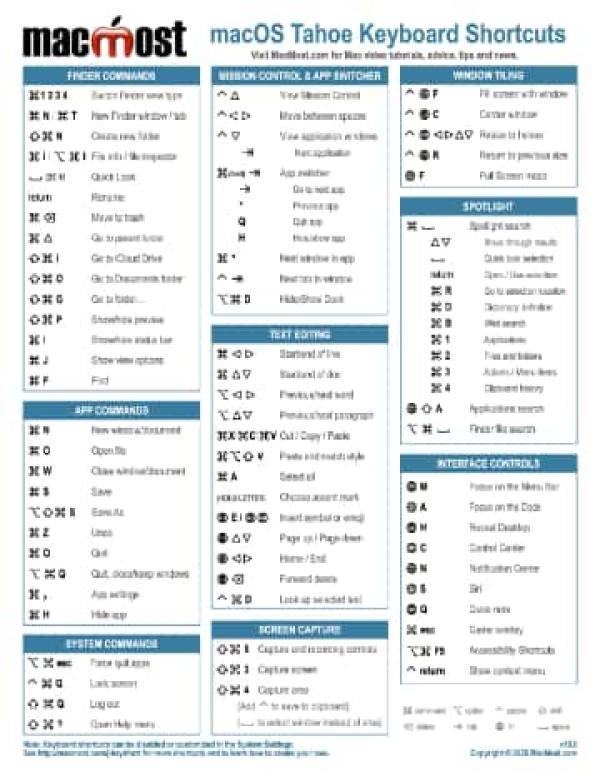
Spotlight has five modes. The Universal Mode which is what you get when you first bring it up. But if you move your pointer you can also see the four other modes here and the Keyboard Shortcuts, Command 1, Command 2, Command 3, and Command 4 that take you to them. People often use Spotlight to launch apps and you can use Command 1 or click here, or there was the ability to set a custom keyboard shortcut for this and it shows you all of your applications. Then just start typing the name of the application and what is the top item there. You can press return and it launches the app. You can use Spotlight to search for files.
You can go to the second option here or Command 2 and now you're just searching for files. But you can also just use the universal mode here and start a file search. Just type the name of the file or some word that's in the content of the file and you'll get results. You can narrow down the search using the little tags up here. So, for instance, if you know you're looking for a Keynote presentation you can just select that and you'll only see results of that type.
You can use the Arrow Keys to get through these. To preview any one without opening it you can use Quick Look which is just the Spacebar. It brings up a little Quick Look window. In addition to the information you see here for each item you can hold the Command Key down and then you can see the path to currently selected item. If you use the Return key it will open up that item in the default app. But you can also use Command R and that will open up a New Finder Window and take you right to the location of that file.
If you want to narrow your search into a particular folder you can do that by searching for the folder first. A quicker way to do that is to use Slash and then start typing the name of the folder like this and you'll only get folder results. Then you can go down to the particular folder you want. Press Return and it will select that folder there at the top. Now you can start typing and you'll only get results in that folder.
Now the third mode for Spotlight gives you access to a whole bunch of built-in actions. For instance, I can go down to the second one here which is Send Message, press return and I can type a message and name some recipients and send a message right here from Spotlight without even opening up the Messages App. There are a ton of different actions you can take for different apps and you can also access your own Shortcuts here. You can also set Quick Keys for these. They'll be set automatically as you use different actions. But you can edit them or create your own. For this one I can change it to add R, like that. Now I can use that to quickly access that action as the first item every time. Also, in this mode, you'll notice you can actually access Menu items using Spotlight instead of the Menu Bar.
The fourth option here gives you access to your Clipboard History. So you can see here the last two things that I copied. You can Search you Clipboard History, click on something to paste it or click here to copy it to the current clipboard, like that.
All of these things are accessible from the Universal Search. So, without using any of these options here you can just stick to the Universal Search and find apps, folders, files, actions, and Clipboard items.
If you find these videos valuable consider joining the more than 3000 others that support MacMost through Patreon. You get exclusive content, course discounts, and more. You could read about it at macmost.com/patreon.
The Universal Mode also allows you to do lots of other things. Like, for instance, quick calculations like this, more complex calculations like this. You can convert units. Here are some examples. (Showing examples). You can also convert currency. Like this or this. You can look for lots of information like time, weather. You can look up dictionary definitions like this. Sometimes it will appear as the first item. If not, you can keep scrolling down to find it. You can even track flights if you know the flight number.
In Universal Mode you can search for a lot more than files and apps. You can search for email messages, fonts, reminders, calendar events, contacts. Just about anything on your Mac. In fact, you can customize what comes up with Spotlight searches by going to System Settings, looking for Spotlight here, and then you get a long list of possible results. So you can turn off any one of these that you don't really need to see and could just be slowing Spotlight down. So Spotlight does all of that and much more. Hope your found this useful. Thanks for watching.
Thank you