
Here are some keyboard shortcuts that you may not know that could help your productivity throughout the day.
▶ You can also watch this video at YouTube.
▶
▶ Watch more videos about related subjects: Keyboard Shortcuts (89 videos).
▶
▶ Watch more videos about related subjects: Keyboard Shortcuts (89 videos).
Video Summary
In This Tutorial
Learn 10 useful Mac keyboard shortcuts you probably don’t know, including ways to manage windows, reveal files, and speed up your workflow.
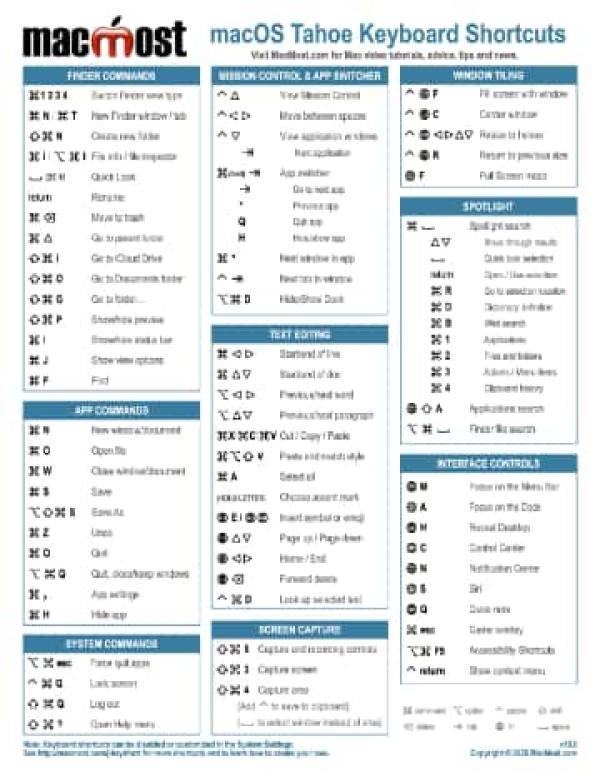
1. Show / Hide Notification Center: 🌐︎N (00:18)
- Use Globe/FN+N to toggle Notification Center.
- Assign your own shortcut in System Settings > Keyboard > Keyboard Shortcuts > Mission Control.
- Can also set a function key, like F12, to show and hide Notification Center.
2. Toggle Do Not Disturb Mode: Custom (01:28)
- Assign a custom shortcut under Keyboard Shortcuts > Mission Control for toggling Do Not Disturb.
- Any key, like F10, can be used as a toggle.
- Be mindful of the “Use F1, F2, etc. keys as standard function keys” setting to ensure it works as expected.
Check This Setting For F-Keys (02:13)
- Toggle the function key setting depending on whether you want F-keys to act as standard keys or special feature keys.
- Needed if you assign F-keys to custom shortcuts.
3. Game Overlay: ⌘esc (03:01)
- Use Command+Escape while in a game to bring up the Game Overlay.
- Works in both windowed and full-screen games.
- Provides quick access to gaming-related controls and modes.
4. Reveal Desktop: F11 (03:58)
- Press F11 to temporarily clear windows and view the desktop.
- Press F11 again to restore windows; it acts as a toggle.
- Customize this shortcut in Keyboard Shortcuts > Mission Control > Show Desktop.
5. Fill Screen With Window: ⌃🌐︎F (04:58)
- Control+Globe/FN+F enlarges the current window to fill available screen space.
- Unlike full screen, it just resizes without entering full-screen mode.
- Works best with windows that can fully expand.
6. Center Window On Screen: ⌃🌐︎C (05:47)
- Control+Globe/FN+C centers the current window without resizing it.
- Option-dragging edges or corners after centering keeps the window perfectly centered.
7. Show the Context Menu: ⌃return (06:30)
- Control+Return opens the context menu for the selected item.
- Acts on the selection, not where the pointer is located.
- Useful in Finder and many apps like Notes.
8. Rename a File: return (07:42)
- Select a file and press Return to start renaming it.
- Press Return again to finish.
- Combine with arrow keys to rename multiple files quickly in Icon or List view.
9. Paste And Match Style: ⌥⇧⌘V (09:03)
- Use Option+Shift+Command+V to paste text without original formatting.
- Keeps the destination style consistent.
- Works in Mail, Notes, Pages, and most other apps.
10. Reveal File Location In Finder: ⌘R (10:29)
- Command+R opens a Finder window showing the file’s folder with the file selected.
- Works in Spotlight, Finder search, Open/Save dialogs, and with aliases.
Summary
These 10 shortcuts help you quickly manage windows, access files, control notifications, and streamline everyday tasks on your Mac. Learning and using them regularly can save time and make macOS more efficient to use.
Video Transcript
Hi, this is Gary with MacMost.com. Let's take a look at some useful keyboard shortcuts that most people don't know about.
So some keyboard shortcuts are more useful than others and some are more well known than others. Here are some that are not very well known but are very useful.
First let's start off with revealing the Notification Center. You usually do this by moving the pointer to the Time at the top right corner of your Mac's Screen, clicking there, and it shows the Notification Center. There's also a trackpad gesture that does this as well and you can do the opposite to get rid of it. But there's a keyboard shortcut for this as well. In fact there's two. There's one that's hardwired in. That's use the Globe or fn key and then N for Notification Center. It will bring it up and the same one will dismiss it. But you can also assign your own. So if you go to System Settings and then down to Keyboard, click on the Keyboard Shortcuts button here. Then look under Mission Control, which isn't obvious that's where it is. You've got Show Notification Center and you can set a custom Keyboard Shortcut that will work in addition to the Globe Key and N. For instance I can double click here and then use, say, F12 for this. Now F12 will bring up Notification Center and dismiss it as well. But also the Globe Key and N still works.
Now while we're here notice the very next item, turn Do Not Disturb On or Off,Of course you have a variety of different focus modes that you can customize and create but Do Not Disturb is probably the main one that most of us still use. The original one before there were even multiple Focus Modes. You can turn it On and Off many different ways, for instance choosing Control Center will usually do it. There's usually a Focus Button here. But you can assign a keyboard shortcut. There's none there by default but you can set something else to it. Like I'll use the F10 key which shows Mute on the keyboard so it is kind of convenient. If I use this you can see Do Not Disturb goes On and it is a toggle so Do Not Disturb Off as well.
Now note that if you're going to use F12 or F10 or any key for this, it's important you also pay attention to the function key setting here and make sure you have this toggled the right way. If you have this turned On then the F key will be used as a standard function keys and you would hold the Globe Key down to use the special features like Mute, or Brightness, or Play. If you have this switched Off then everything is going to be the opposite. So make sure you understand how this switch works and have it set the way you want if you're going to also use F keys for custom keyboard shortcuts.
If you find these videos valuable consider joining the more than 2000 others that support MacMost through Patreon. You get exclusive content, course discounts, and more. You can read about it at macmost.com/patreon.
Now here's a custom keyboard shortcut that works only if you are playing a game and that is the app is defined as a game by the developer. You can see all of these by going to your Apps and then looking just at Games. So here's what I have currently installed. Now if you are running a game it is the front-most app as it is here you can see. You can use the keyboard shortcut Command and Escape and this will bring up a special Control Center that is called Game Overlay. It actually has different modes here so you can switch between these so you can get access to things that particularly apply to games. It works if the game is in a window but it also, most importantly works, when the game is full screen. You can see the little indicator there the first time you use it so Command Escape brings this up and if you have Controls over here as an overlay while gaming.
Now if you like to keep files, folders, or have icons for your drives and things on your Desktop you may find that sometimes you just can't get to your Desktop. You've got a lot of windows going on. You can use a keyboard shortcut to clear everything away temporarily to see what is on the Desktop. So say there is a file there I want to open. I can use the keyboard shortcut F11 and you can see everything clears away but you can still see the windows along the edges here and this border showing that you're in this mode. You can get to your files here and do stuff, like double click a file to open it. Or if you invoked it with F11 and want to dismiss it you can either click on this border here or just hit F11 again, it's a toggle. This is customizable so check in System Settings under Keyboard and then look in Keyboard Shortcuts under Mission Control here. There's Show Desktop. You can make sure it is turned On and you can change it from F11 to something else.
In macOS Sequoia I did a lot of window tiling tools and there were keyboard shortcuts for each one of those. There's one particularly useful and that is to Fill the Screen. So if you click the green button here and of course you go to Full Screen Mode. But if what you want is for the window just to be actually large as it can, well you can use Window and then Fill. The keyboard shortcut is Control and then Globe or the fn key and then F. Which is pretty easy to remember. So this will take the window so the edges go to the edges of the screen. Of course it is if the window is capable of that. So, for instance, if you're doing something like System Settings and you use Control Globe and F it will do the best it can. The System Settings window doesn't expand horizontally. It does expand vertically.
Now a similar command to that is one that will center the window. So instead of kind of having to guess where something is the center and you can go to Window, then Center, and you can see the same command, Control and Globe or fn but C for center instead of F for fill. That will perfectly center the window without changing its size. Then once it's centered you can actually use the Option Key and drag either the left or right side or the top and bottom together and it stays centered. As a matter of fact if you do Option and then drag any corner, like this, all four sides move together but since you've centered it it remains centered by moving all the sides the same amount.
Context Menus are a very useful part of the macOS interface. No matter which app you're in or here in the Finder if you Control Click on something you have a ton of different commands that use the context of whatever it is you've clicked on, in the case the file here. So you Control Click, you can right click on a mouse, or two-finger click on a trackpad to bring up the Context Menu. But there is also a keyboard shortcut for the Context Menu. That is to use the Control Key and Return. So this will act on whatever is selected. Not where the pointer is. So, for instance, if I were to right click now it would act on this file here but that is not what's selected. It's this file that's selected. So Control, Return brings up the Context Menu for this file. Here I am in Notes and if I Control Click, right click, two-finger click right now it will act on the pointer location, like that. But if I use Control and Return it acts on the selection. So not the location of the pointer here but the selected up there, like that.
If you want to Rename a file in the Finder you may used to simply clicking and then if you just click again a second or two later you see you get the file name selected and you can type. I think this is now how most people do it. Although most people may actually select the file and then go to the file and Rename which does the same thing. The keyboard shortcut for this is something you won't find in any interface screen on the Mac. It's just to press Return. So select the file you want, press Return, and that starts the file Rename process. You can use this keyboard shortcut to rename things very quickly. For instance, I'll go to the first file here and I'll go to show Preview so you can see the image here to the right. Now I can select any image I want, Return, type, Return will rename it. Select another image and Return, Type, Return and it will rename it. It allows for pretty rapid renaming files and you can use the Up and Down Arrow keys to move through the images as well. It also works in Icon View. You've got icons like this. You can move around with the arrow keys. Return, Type, Return, rename something. Return, Type, Return and you quickly rename a lot of files.
So when you select text somewhere and you've copied, you're not only copying the text but all the styling, Bold, Italics, links, fonts, colors, and all of that. So when you go to Paste somewhere that also accepts rich text like that you get a lot of that styling. Here in Mail, for instance, you can see that. But there's a way to paste and have it forget all of that. It's often in a different location in the Edit Menu depending upon which app you're using. Here in Mail it's in the third section. It's called Paste and Match Style. I like to think of it as Paste Plain Text. You see the keyboard shortcut is Option Shift Command V. That's pretty universal. So use all of those modifier keys, Option, Shift, Command and V and you can see it pastes the plain text retaining the font and just the regular styling and forgetting all of that from what you copied. The same thing here in Notes. A regular Command V to paste remembers all of the styling there. But if you look here you'll see Paste and Match Style and you've used the keyboard shortcut. You can see it just used the Plain text there. Here in Pages too. Command V pastes it in with all the styles, links, and everything remembered. Whereas you can see Paste and Match Style, with all those modifier keys and V, does it keeping the style, font, and everything you were using while typing.
Now when you search for something in the Finder and you find the result, the thing you're looking for, you can of course double click it to open the file. But instead you actually want to go to the location of this file. The folder that it is in because maybe there are other files there that you're interested in. You can use the keyboard shortcut, Command R, that will open a new Finder Window that will take you not just to that folder but also selects that file there. This works in a variety of situations. For instance in an app, like here in Pages, I can do File Open and when I find what I want I'm here in Pages, in the Open Dialogue of Pages. But Command R still works to open up a new Finder Window, at that location, with that file selected. It also works with aliases. So for instance if I were to take this file and drag it to the Desktop but hold Command and Option down to create an alias, leaving the file there but having an alias to it on the Desktop, but now I can select the alias and Command R and it will go to the folder with that file selected from the alias.
So there are a ton of different situations where you can see a file in a Search in an Open, Save, Export dialogue box, see an alias, and by just selecting it and using Command R you can jump to its location.
I hope you found this video to useful and learned one or two more keyboard shortcuts to work into your daily routine. Thanks for watching.
Ooo Command+R is a new one for me and a good one! Thanks.
I find Paste and Match Style so useful I set f19 as a shortcut [Extended Keyboard] I use it everyday. ⌘R was a new one will be using it for sure. Thanks for all your videos.