
A quick start guide to finding and using keyboard shortcuts and how to create your own and modify existing ones through System Settings.
▶ You can also watch this video at YouTube.
▶
▶ Watch more videos about related subjects: Keyboard Shortcuts (89 videos).
▶
▶ Watch more videos about related subjects: Keyboard Shortcuts (89 videos).
Video Summary
In This Tutorial
Learn how to find, use, and customize keyboard shortcuts on your Mac, including system shortcuts and creating your own custom ones.
How To Find and Learn Keyboard Shortcuts (00:34)
- Look in an app’s menu bar to see available keyboard shortcuts next to menu items
- Match the symbols in the menu to the modifier keys on your keyboard
- Practice learning shortcuts by using them instead of the menus
Common Keyboard Shortcuts (01:13)
- Focus on nine common shortcuts found in most apps first
- Examples include Command+N for new, Command+C for copy, Command+V for paste
- Learning these makes it easier to start using shortcuts across multiple apps
System Keyboard Shortcuts (02:17)
- Use Command+Tab to switch apps, Command+` to switch windows within an app
- Command+Space opens Spotlight
- Shift+Command+5 brings up screenshot tools
- Control+Arrow keys help you access Mission Control and switch spaces
Add Custom Keyboard Shortcuts (03:21)
- Go to System Settings > Keyboard > Keyboard Shortcuts to see system-level shortcuts
- Double-click a shortcut to change it, or create new ones in App Shortcuts
- Type the exact menu item name and assign your preferred key combination
You Can Also Change Existing Keyboard Shortcuts (04:44)
- Use the same App Shortcuts method to override existing shortcuts
- Be careful of conflicts—new shortcuts replace previous functions
- You can always restore defaults if needed
Summary
You can master keyboard shortcuts by learning the ones in menus, using system shortcuts, and creating or changing your own in System Settings. This makes working on your Mac much faster and more efficient.
Video Transcript
Hi, this is Gary with McMost.com. Here's a quick guide to using keyboard shortcuts on your Mac.
Keyboard Shortcuts on your Mac are actually pretty straightforward. When you're in an app, like for instance Notes, you can control most of what's going on in the app by looking in the Menu Bar at the different menus. If you look closely at the items in each menu you'll notice that there is a keyboard shortcut to the right of most of them.
Instead of using the Menu Bar you can use this shortcut to quickly enact this command. To learn a Keyboard Shortcut all you need to do is look at it here in the Menu Bar and notice what those symbols are and match that to the modifier keys on your Mac. So, for instance, for the Format Heading command here in Notes it's Shift Command H.
If we look here on the keyboard we can see the modifier keys along the bottom of the Keyboard. Almost all of them have the symbol on it that matches what you'll see in the Commands in the Menu Bar. The exception is the Shift Key, which just says Shift and doesn't have the arrow pointing up.
So, for instance, in Notes if I want to create a new note I could go to File, New Note. But I can see here that Command N will do the same thing. There are a ton of different keyboard shortcuts in each app. A lot of them are the same across different apps, which makes them easier to learn. In fact there are nine keyboard shortcuts that you'll find in most apps. Don't try to learn all the keyboard shortcuts at once. First focus on these nine which you'll use almost everyday.
But you're not always interacting with the app you're using. Sometimes you're using keyboard shortcuts to switch between apps or interact with the system. There are lots of these, but here are five to concentrate on. Use Command Tab to switch between apps. Command and the back tick key, which is just above the Tab on US keyboards, to switch windows in the same app. Use Command Space to bring up Spotlight. Shift Command 5 will give you access to all of the different Screenshot Tools. For using Mission Control simply remember Control and Up Arrow to access Mission Control or just Control Left or Right arrow to just jump between different spaces.
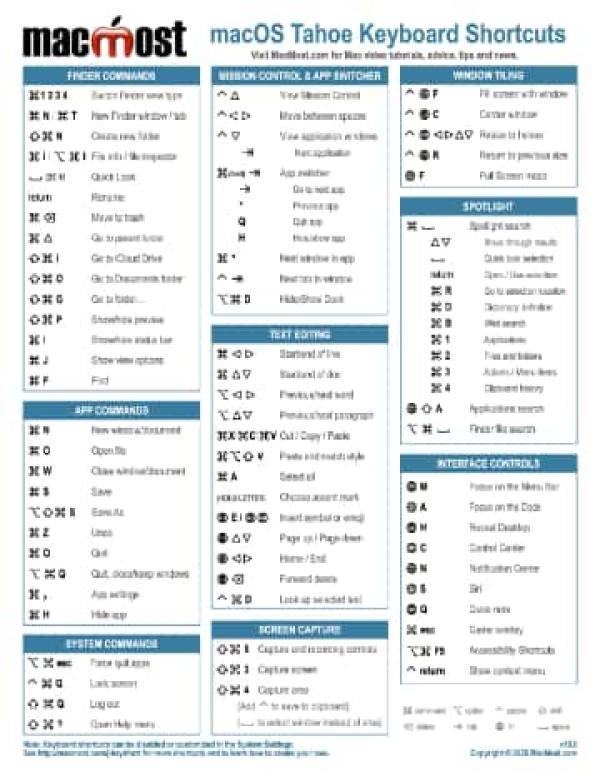
If you like having a reference for Keyboard Shortcuts, like this, I've got a free PDF that you can download and print out.
Now besides the Keyboard Shortcuts you'll find inside of apps, you'll find more if you go top System Settings and then scroll down on the left to find Keyboard. Then click on Keyboard Shortcuts. This brings you to a special interface that shows you some System Level Keyboard Shortcuts. For instance, here are all the Mission Control keyboard shortcuts. You'll also find all of the ones for Screenshots and for other things that you can do, on your Mac, that aren't necessarily for a single app.
If you find these videos valuable consider joining the more than 3000 others that support MacMost Through Patreon. You get exclusive content, course discounts, and more. You can read about it at macmost.com/patreon.
Now you can also customize these keyboard shortcuts. So just find the one that you want and double click here. Now you can type the replacement keyboard shortcut. I use Shift Command P for Save Picture of Screen as a File. You can do that as many times as you want. Like I'll use it to change it back and you have a Restore defaults button here that'll restore the defaults for this section.
But you can also do this for the shortcuts inside of apps. For instance in Notes here, under Format, I can go to Font and then Strikethrough. But there is no keyboard shortcut for that. So I'm going to create one. Note the exact name, spelling, and capitalization counts for the menu item. In this case Strikethrough, all one word spelled exactly like this. Now back in Keyboard, Keyboard Shortcuts in System Settings I'm going to go to App Shortcuts here. I'm going to click the Plus Button and I'm going to select the application. In this case it is Notes. Then I'm going to type the Menu Title and this is where it has to be exact. So I've typed it exactly as it is shown in the menu. Now I'm going to click here and then type the keyboard shortcut. I'm going to use Shift Command S. It will add it there. Then I'll click Done. Then I'll see that keyboard shortcut show up here in this list.
To Verify I'll go back into the Notes App here. Go to Format, Font and you can see the keyboard shortcut show up here. If you don't see it there that means you typed the name wrong. So now I can use Shift Command S for that menu command instead of having to dig down into the menus.
But it is up to you to worry about conflicts with these keyboard shortcuts. If you assign a keyboard shortcut to another menu item and it was already in use then the previous one will stop working and the new one will work instead. You can also do exactly the same to change any of these. So if I wanted to change Bold to Shift Command B I could just add it in System Settings, like I showed with Strikethrough.
So those are the basics for finding, using, and customizing Keyboard Shortcuts on your Mac. Thanks for watching.

Good job. Personally I would suggest to help someone memorize the shortcut, look it up (going to the file menu for example), then do NOT pull down, instead close that area and manually on the keyboard invoke the command.
Thank you
Is there any concept of the chosen modifier having specific meaning? For instance, the command modifier being used to do one class of things; but control modifier being used for another other class of thing.
Also, are the modifier symbols meant to look like something in the real world? The option one makes me think of superscript or maybe subscript.
Steve: Loosely, yes. Command is the main key for keyboard shortcuts (commands). Option gives you alternatives. Shift will "shift" the meaning of the shortcut. More-or-less. The Option key ⌥ is like track switching (think trains) there the track is shifted so the train follows another path.
Thank you, Gary