
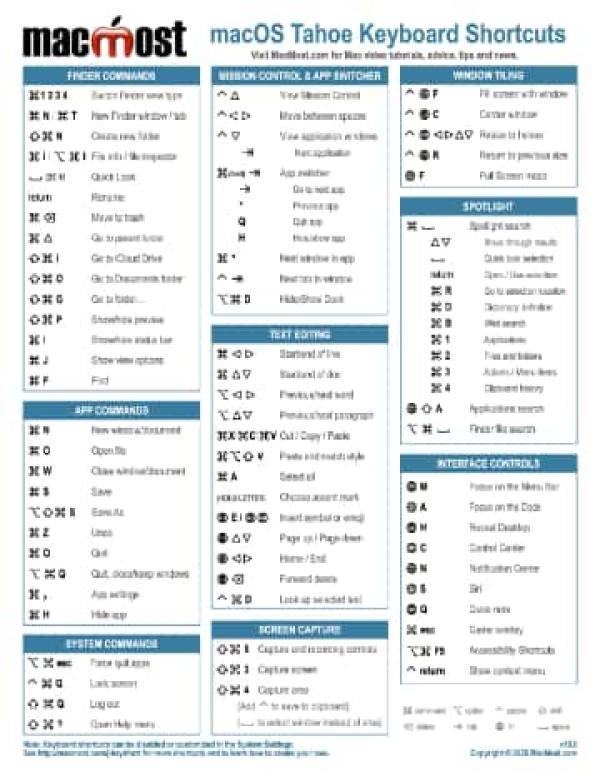
I'm going to run through all sorts of keyboard typing techniques about moving your cursor, typing special characters, lots of odd and unusual shortcuts that can help with typing.
▶ You can also watch this video at YouTube.
▶
▶ Watch more videos about related subjects: Keyboard Shortcuts (89 videos).
▶
▶ Watch more videos about related subjects: Keyboard Shortcuts (89 videos).
Video Summary
In This Tutorial
Learn how to type faster and more efficiently on your Mac using keyboard shortcuts. You'll see how to move the text cursor, select, delete, type special characters, and use text replacements without reaching for the mouse.
Moving the Text Cursor With the Arrow Keys (01:33)
- Use the arrow keys to move the text cursor one character or line at a time.
- Up and down arrows move to the nearest character in the line above or below.
- This is the basic way to navigate without using the mouse.
Moving By Word With the Option Key (02:34)
- Hold Option and use left/right arrows to jump one word at a time.
- Option + Up/Down moves to the beginning or end of the current paragraph.
- Useful for quickly navigating through large blocks of text.
Using the Command Key To Move By Paragraph (04:12)
- Command + Left/Right moves to the beginning or end of the current line.
- Command + Up/Down jumps to the start or end of the entire document.
Using Shift To Select (04:42)
- Hold Shift with arrow keys to select text in that direction.
- Combine Shift with Option to select by word or paragraph.
- Combine Shift with Command to select to the start/end of the line or document.
Delete and Forward Delete (06:38)
- Delete key backspaces; hold Option + Delete to delete by word.
- Command + Delete removes to the start of the line.
- Hold Fn (Globe) + Delete to forward delete; combine with Option to delete forward by word.
Unix-Style Keyboard Commands (08:24)
- Control + A moves to start of a line, Control + E to end of a line.
- Control + F/B move forward/back a character; Control + P/N move up/down a line.
- Control + H deletes backward, Control + D deletes forward.
- Control + T swaps two characters; Control + K and Control + Y act as a secondary cut and paste (kill/yank).
Typing Options and Substitutions (13:06)
- Double space can insert a period and space if enabled in Keyboard settings.
- Smart quotes and smart dashes automatically convert plain characters to typographic ones.
- Check System Settings > Keyboard > Text Input for these options.
Typing Accent Marks (16:34)
- Hold a key (like E) to bring up accent options and type accented characters.
- Works with letters that have alternative forms such as A, I, O, Y.
Typing Special Characters (17:28)
- Press Control + Command + Space or Fn + E to bring up the emoji & special character viewer.
- Use search to find symbols, emoji, or Unicode characters quickly.
- Switch to the Character Viewer for more details and multiple character sets.
Typing Unicode Characters (20:56)
- Use the Character Viewer search with U+ followed by the Unicode number.
- Add the Unicode Hex Input keyboard in System Settings to type characters using Option + Unicode code.
Text Replacements (24:21)
- Set up shortcuts for words, phrases, or emoji in System Settings > Keyboard > Text Replacements.
- Typing the shortcut followed by space or return automatically expands it.
- Great for long signatures, links, or frequently used phrases.
Summary
Use keyboard shortcuts to move, select, delete, and edit text without leaving the keyboard. Combine Option, Command, and Shift for fast navigation, use Control for Unix-style commands, bring up special characters with emoji viewer or Unicode input, and speed up typing with text replacements.
Video Transcript
Hi everyone, this is Gary with MacMost.com, and in today's live episode, I want to take a look at all sorts of tips and tricks for using the keyboard on your Mac to type.
Alright, so when you use the keyboard on your Mac to type, a lot of people like to keep their hands on the keyboard and not use your pointing device like mouse or a trackpad.
With a mouse or trackpad of course is really easy to click and place the text cursor where you want it and double click to select, click drag to select and all of that.
It's really easy with the mouse and trackpad but it does break your flow if you're good at typing and you're typing something long like a report or you're working on a book or story or whatever.
So it's useful to know all these cool tips and tricks for just using the keyboard when typing to move around and mainly what you're going So this thing you see moving around here that looks like a little arrow or if it's over text, it looks like what's called an I-beam.
That's called the pointer.
The cursor is the little blinking line.
You could see it here just to the left of the word quick right there.
That's called the cursor and that is in text.
So pointer is something that moves around your entire Mac screen with your master trackpad, cursor is something that appears inside of text.
if you want to be tactical about it.
Now, the idea here is to be able to move that cursor around with only the keyboard, because it's easy to do with the mouse or trackpad, but what if you don't want to use that while you're typing? And of course, the arrow keys are the main thing you would use.
I'm going to increase the size here so you could see what's going on.
And notice I've got this little keyboard, not so little actually, this keyboard here where you can see what I'm typing.
So I've got the text cursor blinking there right before the word quick.
And if you look at what happens when I press the right arrow key, and you'll see that reflected there on that keyboard when I'm pressing, the right arrow key moves the text cursor to the right, left arrow key moves it to the left, down goes down to the closest spot between characters So it's not like a completely linear down because sometimes the letter is right there in the middle like when you go between these two And yeah, you can do up as well.
So that's kind of obvious, right? That's how you would move around but it's kind of tedious too If you've been typing and you want to go back a bunch you got to just keep smashing that left arrow there So what can you do to make that a little easier and the key? Is to use the option the key key is to use the option key So I'm gonna hold down the option key and you could see that on the keyboard there If you use the option key then moving to the right or left with the arrows moves an entire word.
So option right jumps per word option left jumps per word back and notice how it's always placing when you go back it's placing it at the front of the word and when you Go option right.
It's always placing it at the end of the word So this is a really quick way to move around in your text, holding that option key instead of just using the arrows.
Now, you also have the ability to do that with the up and down arrow keys.
So if I do option down, it's going to go to the end of the current paragraph.
If I go option down again, it goes to the end of the next paragraph.
Option up goes to the beginning of the paragraph.
So it's useful to think of this as going to the boundary because it's like, Why is it going to the beginning of the paragraph when I go up and want to go down, option down, it's going to the end of the paragraph.
It's going to the boundary of the current paragraph.
So the starting boundary and the ending boundary.
And then if you could do it twice, it goes to the starting boundary of the paragraph above like that.
So yeah, you could use the option key to move around very quickly.
The command key, so it's command, not control, also does some things.
If I use Command + Right Arrow, it goes to the end of the line, the actual virtual line there.
So you could see how it jumped to here.
Command + Left goes to the beginning of the kind of the virtual line, like that.
Command + Down goes to the end of the document.
Command + Up goes to the beginning of the document.
So Command also has some uses.
Now, you can use all of these in conjunction with the Shift key.
So like if I wanna select text, I could select text like this with the pointer using my track pattern mouse, right? And a cool tip is you could double click and it selects by word.
So double click like that.
Double click and then drag selects by word as you drag, whereas a single click and drag will select by character.
But let's get back to using the keyboard.
If I have the cursor like right here, and I wanna select text, I could use Shift, hold the Shift key down for selection, and then the right arrow will select from that spot where I started, and allow me to select more and more characters.
Left arrow will change that selection, and I can go to the left to select characters behind the cursor.
So you could start here in the middle of the word quick, Shift right, shift left and keep going.
You can also do that with the down arrow.
So I can start here and do shift down and it's gonna select by line, just as if I was moving down by line, but it's holding the selection as I do it.
Now you can combine that with the option key.
So option, remember, will go one word at a time, forward, back, shift option, will select one word at a time, forward or back.
And then Shift + Option and then down goes to the end of the paragraph, like that.
So you could do, if you wanted to select an entire paragraph, one way to do it is Option + Up to go to the paragraph boundary at the beginning, Shift + Option + Down, like that, will select to the end.
So, quick way to select a paragraph there.
You could do it by triple clicking as well if you go back to using mouse and trackpad for that.
So some cool stuff there.
You could also apply all of this to deleting.
So I'm gonna put the cursor there right after word dog.
And of course, if I press the delete key on the Mac keyboard, it backspaces like that.
I'll undo there.
If I hold the option key down, as you can guess, it's going to go back one word.
So you can delete per word by using option and delete.
And as you might guess, if I do Command and Delete, it deletes back to the beginning of the line.
And then if I do the, let's see, Option, Command, Delete, that doesn't do anything.
So, doesn't always work for all the combinations.
Now, another thing about Delete, I can't talk about Delete without talking about the fact you can delete in both directions.
Just using the Delete key, the way to do that is, I'm gonna put the, I'm gonna place the cursor here right in the middle of the word occurrences.
So if I wanna delete characters, I can just press delete.
If I wanted to delete forward, something that lifetime Mac users don't really ever do, but if you use Windows, you might even have it.
The key is to hold down the FN or globe key.
On this little keyboard shows FN, you can see me holding it down there, but on newer Mac keyboards, the globe is the more prominent symbol.
Hold that down and then press Delete and it deletes forward.
Now, this works with the option key as well.
So globe or fn key and option, there we go, deletes to the end of the word and continues to delete words forward.
So that's how you do that.
If you want, there are a bunch of other commands that use letters.
And this goes back to Unix keyboard commands.
Back when Unix keyboards did have these modifier keys.
And Apple's adopted them and they work in most apps.
A third party app doesn't necessarily need to use them.
A lot of them just inherit it from using Apple libraries.
So if you wanna move to the start of a line, control.
So it's the control key this time, not command, not option, but control.
And then you do A and that should, oh, and let's see.
I want to do, is it not working? Maybe that one doesn't work.
Control A, control E.
I might press.
So, control A doesn't seem to work.
That was in my list.
Or actually, it looks like I'm triggering, ah, ah.
So I'm triggering something in shortcuts there.
So Ctrl+A moves to the beginning of the line, but a shortcut I have that's used in that is the keyboard shortcut is getting in the way.
Ctrl+E.
That goes to the end of the paragraph, and it stays there.
So notice if I place the cursor there, and I do Ctrl+E, it jumps to the end of the paragraph, but it doesn't go to the next one.
So it just stays there, and Ctrl+A would go to the beginning of the paragraph and stay there.
Now, if you want to go forward a character, like you would usually use the right arrow key here, you could do control F goes forward, control B goes back.
So no reason not to use the arrow keys for that, but it is interesting to see this works.
You can go to the previous line, command P goes up to the previous line, command N goes down.
So this is like the up and down arrow keys.
You could do delete using Command + H.
We'll delete back.
It's like backspace.
And Command, or sorry, it's not Command, it's Control.
Control + H, deletes.
Control + D, forward deletes.
So I told you there was another way to do a forward delete.
So H and D.
You've got, Here's a really weird one.
So look at the word brown there.
So I've got the text cursor between O and W.
If I do Control + T, it swaps those two characters.
Now, why would you wanna do that? Well, I don't know, I guess some people might have used for it.
It's probably just easier if you actually make a mistake with two characters that are in the wrong order, to just correct it in the rare instance, but you can do that.
Now, there's also a weird thing with these UNIX key commands for copy and paste.
So obviously, you select what you want.
I'm gonna use the keyboard to, it's the option back to go to the beginning of the word, shift, option, right arrow, select a couple of words, and I can do command C to copy.
I can do command X to cut.
I'll undo that and I can do command V to paste.
These are standard, we've been using these for decades.
But if you want, you can also do control K.
And what that does, that command isn't cut, that's kill.
It's the same thing as cut, right? It's gonna take what was selected and it's going to get rid of it, but it puts it in not the clipboard, but another place.
And you can use control Y to bring it back.
So you can say select these two words and command C to copy or command X to cut.
Then you could do these two words and do control K to kill.
And then you could do command V to paste and control Y to bring it back.
It's called the yank, killing yank.
That's the two commands there.
So you have like a secondary clipboard you could use that's the Unix clipboard.
It's kind of neat to talk about, but probably doesn't have too much use for people.
Let's look at some other typing tips here.
I'm gonna go back to your larger view of things so we can see a little bit better.
There, so now we could see everything.
You could still see my keyboard here at the top, right? But we have a little more room.
I wanna go and show you what happens.
Let's say you're at the end of a paragraph or end of a sentence and you wanna type a period, right? You would normally type period and then you would do space and then you would start typing the next sentence.
You can press two spaces and notice how two spaces gave me period space.
This is a setting.
Go into system settings here, bring this up, see, go to keyboard, and you think it would be here, but it's actually under text input, input sources, edit the input sources, and most likely you've got just your one keyboard right here, but all input sources here, and then a bunch of interesting settings under all input sources.
And one of those is add period with double space.
So that's kind of interesting, cool if you like it.
This is really especially useful for people that type a lot on mobile devices, could be an iPad but more likely an iPhone, 'cause this is kind of a keyboard shortcut or a shortcut typing thing that's been around for a long time using the iPhone.
And if you've gotten used to it there and then you find yourself on the Mac, you might find that sometimes you rely on it.
There's a bunch of other stuff here like capitalizing words automatically, correcting spelling automatically.
There's smart quotes and dashes.
And what smart quotes do is if I, you know, turn that off and I type a quote like this, well, they'll actually see.
He just has its own setting, of course.
So you'll find these under, uh, edit and then, um, substitutions.
You've got smart quotes and smart dashes.
So you kind of have like an app setting in the edit menu.
and sometimes in the settings for that app, but you also have like a system wide one for if the app doesn't have this.
But smart quotes, if I turn it off there and I type a quote, it's a straight up and down quotes.
And then I type something and straight up and down.
But if I have smart quotes on, and I will go here, smart quotes, then it will go and do the left curly quotes and the right curly quotes.
I did a video on this recently.
Does it for single quotes, and there was also here smart dashes, which means if I do dash dash, it converts it to a long or M dash.
And you can find the, smart quotes and dashes here, the override for that, for like if the app doesn't have its own setting.
And then you can choose the type of double quotes or single quotes you want to use that fit your region.
So that's kind of interesting to use and could save you a lot of time.
There are ways to type curly quotes on your own.
You can hold the option key and the left square bracket or option key shift left square bracket or option key right square bracket or option key shift right square bracket.
And you could see all that over here as I was doing it.
So that's kind of cool.
Let's take a look at using accent marks.
So if I want to type like a word, like cafe, I could type E and it's not going to have the accent mark over it.
But if I want the accent mark, I just press and hold the E and then I get this little cool menu here and I can click on one of these or select the number and it will give me the accent mark.
And that works for any letter that has an alternative, like O has it, I has it, Y has it, but like W, W does have one, Q does not.
So nothing appears, but like W has that one, so I can hold down and select it.
So that's useful to know, and it's a great way to be able to type the full set of characters, regardless of what your language and region settings and everything else are.
You could also bring up the emoji and special character viewer.
So you can do that with two different keyboard commands.
Ctrl + Command + Space brings up the emoji and special character viewer, and it has a little pointer pointing at where it's going to put the character.
And then you can just search through this.
You can go through the list of emoji characters, or you could search for something to narrow it down and then click on what you want.
But, and it'll give you like reasons here at the top, but the search is really useful because the search could go way beyond emojis.
So for instance, I am always using this.
I'll search for triangle and get these little triangles.
Some of these are the emoji characters.
Some of these are what are called Unicode characters, characters that are not part of the emoji set.
They're usually monochrome, but here's a triangle facing right.
That's really cool and all.
And there's another keyboard shortcut for that, F, N, or the globe key, and will bring it up and sometimes it'll bring up a suggestion.
So if I type the word coffee and then do this, well it's not doing it now of course, but it may just give me the coffee cup and then you have to do it a second time and I'll bring up the full set.
So let me show you what happens though, if you want even more from this, if you want more, notice at the bottom, you can jump to like different sets here And you can click here on the arrow to go all the way over.
And you could see the rest of the sets.
And then you have this little button here at the bottom right.
Click on that, and it switches to the character viewer.
The character viewer is the old thing that came up.
The emoji and special character viewer replaced it.
But you can still switch back to the character viewer because it gives you a lot more.
It gives you, for instance, a really close look at the characters, information about them, like the name and everything like that, which is really cool.
And note that once you switch to the character viewer, you're now using the character viewer, the keyboard shortcut brings up the character viewer.
You could still double click and type, and the character viewer actually stays up so you can actually type multiple things, which is kind of neat.
If you wanna switch back to the emoji viewer, click the little button.
It's the same button here at the top right.
It switches back to it, and now when you bring it up, it brings it back up the way you wanted before.
But while you're in this, you've got a nice search feature that seems to work a little bit better, and you also have the ability to go to actual character sets here on the left, and click this button, which allows you to customize the list and add sets that you may not normally have.
Sets for lots of other languages, but also things for signs and standard symbols, technical symbols, things like that, geometrical shapes.
Done.
And now these are added and I can actually browse these, but also I'll see them now in the emoji viewer.
They will appear here.
They should at least.
So this is really cool.
You can also when you select a character like this, you could see like what it's called like that.
Sometimes you get a Unicode thing here telling you what you can actually expand this.
See related characters, font variations, all sorts of cool stuff.
So that's really cool and you could search for something.
You could also search by Unicode character.
So if you search for 266C, it gives me what 266C is, which is the musical note thing here.
Bean 16th notes is the Unicode character.
So if you know about Unicode characters, you can use that.
But you could also do that here.
266C, you have to put U+ in front of it.
There you go.
U+ and then type the Unicode thing and you'll get it here in the emoji in special character viewer like that.
So some tips there for getting all these weird special characters.
Oh, I'm gonna throw in one more.
If you like Unicode characters, you can go in system settings and you could go to keyboard, and then keyboard you can change input sources, and you could add an input source, and you may think, oh yeah, these are all languages.
Well, if you go all the way to the bottom, there's one called others, and you've got Unicode hex input.
Add that, and now you've got this here.
Make sure you have show input menu and menu bar.
Now you could go to the input menu here, switch to the Unicode hex input keyboard.
This is, it still looks normal.
You can still type normal characters and letters, but when you hold the option key down, hold it down and then type a Unicode set like 266C, you get that character.
And notice when I did that option, I typed 266, it actually gave me some characters on the keyboard that start with something.
And so I could go and say, oh, I'm gonna type the number one, which seems to be a heart.
So kind of neat if you like Unicode characters or use them for work or for whatever, you've got this Unicode hex input keyboard option.
And now you can switch between it here once I've enabled it.
So that's really cool.
And I've got one other tip that you know I was gonna get to if I'm talking about typing things.
But before I get to that, I do wanna mention of course, that this video and all my videos come to you thanks to all the people that support MacMost through Patreon.
So I've got 3,000 people that support MacMost this way.
It is the primary thing that keeps MacMost going if you go to macmost.com.
If you get the weekly newsletter, which is completely free, both of those have no ads in them.
The reason they have no ads in them is because of my Patreon support.
And if you do support MacMost through Patreon at the Cloud MacMost level, there's different tiers and stuff, the Cloud MacMost people, they get extra stuff.
I post one or two extra videos a week for them, just covering different topics, a little different than what I usually post at YouTube too.
You kind of see what's available.
Actually post the links to those at acmost.com and in the newsletter so you can kind of get to taste for what it is I post to Patreon.
And there are core I have courses and there are course discounts for supporters as well.
So a big thanks to my MacMost supporters for all of that.
So I'm gonna finish off by talking about of course text replacement.
So go into system settings, go to keyboard and then go to the text replacements button here.
You can also get to this really easily by going to text replaces searching for text replacements here in the left and you know the new spotlight is really good at getting you there too.
If you search for text replacements you can go to it.
I've actually got some things I've called that with shortcuts but you could see it right here with a little system settings thing and that takes you right into system settings into keyboard and then hits the text replacements button for you.
And what What text replacements do is they allow you to put a little set of characters and then what they will go and represent.
So for instance, you can use them for emoji characters like you're always typing the pizza slice thing and you don't want to bring up the emoji in special character viewer.
I've set exclamation point and the word pizza to a pizza slice.
You've got some defaults here like left paren, c right paren changes to the Unicode character for copyright.
You could do a whole bunch of different things here like I had NT report set to type out project report colon name, OMW to on my way exclamation point, that kind of thing.
So you could even have corrections in here.
Like if you type they with an L after it by accident sometimes, it can autocrack to the word "they," that kind of thing.
"TYVM," thank you very much.
And it could be something really long, like exclamation point, "cust" for customer, and then "re" for response, so "custre." And this in here is actually a really long response.
It's not easy to type in this field.
If you want to do multiple lines, it's not easy to do it, but you can always type it out, text edit pages, whatever you like, and copy and paste in here.
Here's one that's legal for legal notice as an example, and this is multiple lines.
Let's try some of those out.
Here I am in pages, but this could be in mail or whatever.
And then you could see it there as a suggestion.
I hit the spacebar, type return, and it will paste that in.
Remember there was the legal one.
And the reason I put an exclamation point in front of it like that was because I wanted it to be something I couldn't accidentally type.
Right? But there was pizza, like that, and it replaces it with a slice.
super useful for all sorts of things.
It help you type, to help you correct things you mistype or just have all these long passages in there and it's just regular text when you're done.
So you could kinda change it.
I think I had an example there where I did that.
So go back into keyboard and text replacements.
And there's this one like J temp, mood colon, good, math, bad, that kind of thing.
So things that include emoji and special characters and stuff.
Links, he's like a link to a video about scams.
So I don't have to remember the link, I can just remember it's mmscams.
and I had space or return and it puts that in.
So if I wanna say, yeah, check out my video here, I can remember that IMM, which is never gonna be a regular word.
And then scams, keyboard, whatever, I've got links like that set up.
So some really cool useful stuff for text replacements.
Definitely it's like the secret that a lot of people use for being really good at typing fast.
use text replacements for small things, big things, whatever.
Let's see.
So yeah, I've got, I've got, yeah, there's some useful tips here.
Hopefully I cover lots of stuff.
You could see there was one point where I didn't show quite what was going on with things, but I corrected it later.
So hopefully that had it for everybody.
But yeah, it's really useful to have stuff.
I know people are gonna ask about how I got this up on the screen.
So that is simply something that's in the accessibility settings for getting that keyboard up there.
I'm trying to remember where it is now.
But it's in here, visual, let's see.
accessibility keyboard, so there it is.
No, that's not it.
Yeah, I didn't know that is it.
Turn it off, you see it's gone.
There it is, and it's on.
So that is unkeyboard, the keyboard settings for accessibility.
And yeah, search for accessibility keyboard.
And you've got full keyboard access sticky keys and for accessibility keyboard and you can set that up and you can even change its appearance and stuff.
You chose the light one because you could see the modifier keys a lot better.
Like that.
So anyway, I hope you found this useful and got something out of it.
Thanks Thanks for watching.

Hey Gary, this was a very good post! Now I'll been able to add some cool tips and tricks that are fun and time saving.Thanks!
This presentation came at the right time for me as I am keen throw away my “mousetrap” !
Always great tips! Thank you Gary!😊