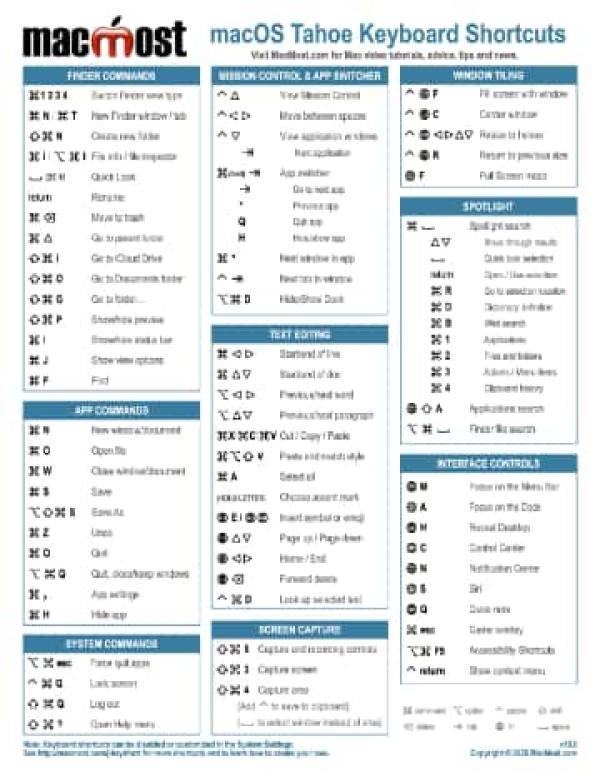
There are many ways to select portions of text on a Mac. If you use your Mac to write, you should learn the keyboard techniques you need to select characters, words, lines and paragraphs.
▶ You can also watch this video at YouTube.
▶
▶ Watch more videos about related subjects: Keyboard Shortcuts (90 videos).
▶
▶ Watch more videos about related subjects: Keyboard Shortcuts (90 videos).
Video Summary
In This Tutorial
The many ways to select portions of text on a Mac, focusing on keyboard techniques for selecting characters, words, lines, and paragraphs, along with mouse methods, search-and-select, and non-contiguous selection.
Intro
- Writing is one of the main things people do on a Mac, whether a book in Pages, a quick email, or a web form, and editing often requires selecting text. There are many ways to do this with the trackpad, mouse, and especially the keyboard.
Basic Mouse Selection
- The basic method is to click at the start of the selection and drag to the end with the mouse or trackpad before releasing. Clicking alone places the cursor anywhere you want.
Selecting Characters and Words
- Double-clicking selects an entire word and triple-clicking selects an entire paragraph, and you can drag after either to extend the selection by word or by paragraph. With the keyboard, the arrow keys move the cursor, Option moves by word, and Command jumps to the start or end of a line, while holding Shift with any of these turns the movement into a selection, so Shift-Option-Right Arrow selects by word.
Lines and Paragraphs
- Shift-Command-Right Arrow selects to the end of a line and Shift-Command-Left Arrow to the beginning, while Shift with the Up or Down arrow extends the selection across lines, keeping the cursor at a similar horizontal position. Adding Option, as in Shift-Option-Down Arrow, selects to the end of the paragraph, and Shift-Option-Up Arrow to its beginning.
Whole Lines and Paragraphs
- There is no single shortcut to select a whole line, but combining Command-Left Arrow with Shift-Command-Right Arrow selects the entire line you are on. For a whole paragraph, use Option-Up Arrow followed by Shift-Option-Down Arrow.
Select All
- Command-A selects all the text regardless of where the cursor started, matching the Select All command in the Edit menu. Selection is limited to the domain of the text, so within a separate text box Command-A selects only that box's text and not the body text around it.
More Mouse Selection Techniques
- You can combine the Shift key with the mouse by placing the cursor, then Shift-clicking elsewhere to select everything in between.
Search and Select
- Searching for text with Command-F selects the first match, and closing the Find window with Command-W leaves that text selected. This can be quicker than pressing arrow keys repeatedly, especially when you cannot see the target text, and Command-G via Find Next jumps to and selects the next match.
Non-Contiguous Text Selection
- Non-contiguous selection works only in certain apps such as TextEdit, because apps like Pages and Mail use different text engines. In TextEdit you can hold Command while selecting to pick non-adjacent pieces that copy together, or hold Option to select a rectangular block, and you can copy text into TextEdit to use these techniques and paste the result back.
Summary
A wide range of keyboard combinations using Shift, Option, and Command lets you select text by character, word, line, or paragraph without leaving the keyboard, supplemented by mouse methods, search-and-select, and non-contiguous selection in apps like TextEdit. Learning these techniques makes editing text far more efficient.
Video Transcript
Hi, this is Gary with MacMost.com. Let me show you some shortcuts for selecting text on your Mac.
MacMost is brought to you thanks to a great group of more than 1000 supporters. Go to MacMost.com/patreon. There you can read more about the Patreon Campaign. Join us and get exclusive content and course discounts.
So one of the main things people do on their Macs is to write. Whether you're writing a book in Pages, a quick email, or just filling out a form on a webpage sometimes you need to select text to edit it. There are many different ways to select text. I'm going to show you a bunch of different ways to do it with the trackpad and mouse. Mostly I want to focus on doing it with the keyboard.
Now I'm going to use Pages here as an example but you could be writing text in just about any app on your Mac. Now if you want to select some text the basic way to do it is to use your mouse or trackpad and click at the beginning of the selection and drag and then release. Then you select some text. But there are a lot of other ways to do it as well. First let's look at ways to do it with the mouse and trackpad. You can place your cursor anywhere you want by just clicking. But if you want to select some text you can double click on a word and it will select the entire word. If you triple click it will select the entire paragraph everything up until the next new line or line break. You can click and drag for words and paragraphs as well. So if I double click on a word and drag it's going to grab by word. If I triple click and then drag it will select by paragraph.
Let's focus more on using the keyboard. After all if you're writing then you probably have both hands on the keyboard and it's inconvenient to move one of those hands to the mouse or trackpad to do a selection. So first let's learn how to move the text cursor because that's the key to selecting. You could see the blinking cursor here. To move it, of course, I would just use the arrow keys. I can move to the right with the right arrow, to the left with the left arrow. Now if I want to move by word I can hold the Option key down. So holding the Option I can move to the right and it will jump by word. If I hold the Command key down it will jump to the end of a line or with the left arrow to the beginning of a line. Now selecting text is just a matter of holding the Shift key with anyone of those actions. So I'm going to hold the Shift key down and use the right arrow to move the cursor. As I do so, because I have the Shift key down, it's actually going to select each character that I move over. Likewise if I hold the Option key down I know I'll move by word and if I hold the Shift key down that will be a selection. So Shift and Option together and I move to the right it's going to select by word. This makes it really easy to select large portions of text fairly quickly. For instance if I was at the end of something I just typed and I want to erase the last few words I could do Option Shift and left arrow to select the last few words and then just start typing to replace what's there.
Now likewise you can use Command to move to the end of the line and if you use Shift and Command it will select everything to the end of the line. If you do Shift Command and the left arrow it will select everything to the beginning of the line. But you could also use the Up and Down keys to go up to the previous line and down to the next one. So you could do the same thing with Shift and it will select everything from where the cursor started to where it ended. It could, for instance, select from here down by using Shift and Down Arrow. You could see the cursor is always going to be located kind of in the same horizontal position as it was where you started. But if you hold down the Option key and you use the Down Arrow it will move to the end of the paragraph. So, if you do Shift Option Down Arrow it will select from where you were to the end of the paragraph. Likewise Shift Option Up Arrow will select from where you were to the beginning of the paragraph.
Now what if you wanted to select the entire line or paragraph? Well there's no single keyboard shortcut to do that but it's easy to use a combination to do so. So we know that Command left will go to the beginning of a line. Command right will go to the end of the line. So just followup Command left with Shift Command right and select the entire line. So that's Command left, Shift Command right and you've selected the entire line you're on. For the entire paragraph you could do Option Up arrow and then Shift Option Down arrow.
Now what if we wanted to select everything? All the text. Well, there's a keyboard shortcut for that, that's different than the rest of these. It's simply Command A. If you go to Edit you'll usually see Select All as Command A. So just Command A selects everything. It doesn't matter where the cursor started because you're selecting everything. Now selecting All depends on the domain of the text. So here I've created a text box. It's separate from the body text. So if my text cursor is in it and I use Command A it's going to select all the text in this box. It's not going to include the text that's in another element, in this case the Body Text out here.
Now back to using the mouse and trackpad for a minute, you could also use the Shift key with that because you've got the cursor here and you want to select everything to say here, you can hold the Shift key down, click, and it will select everything from where you started to where you ended.
Another technique for selecting text is to simply search for the text because you will end up with the selection of what you searched for. So I'm going to do Command F. I'm going to type the word I'm searching for, and you could see it selects the first one. I can simply do Command W to close the Find window there. You could see the text is selected. Now this may seem like a lot of key strokes but it maybe less than actually using the arrow key a whole bunch of times to get exactly where you want especially if you can't see where that text is located. Also, you can use the Edit, and then Find Next, Command G, to quickly go to the next one. So a quick Command G selects the next word that matches and you can continue through. That is an often overlooked way to select text that's handy in many different cases.
Now I know a lot of you are going to ask about noncontiguous text selection on a Mac. You can only do that in certain apps like TextEdit. There are different engines inside of apps like Pages and Mail and TextEdit so that some of them support noncontiguous selections and others do not. So here I am in TextEdit and you can, of course, Copy and Paste from Pages into TextEdit if you really wanted to do this. You can select text just as before but you can also hold down the Command Key when selecting text and select noncontiguous parts. Then when you copy it would copy all of this together as one piece of text. You can also hold down the Option key and select a rectangular area, if you want, and select All of the text that is shown here. Probably not something that most people need but if you get some document from somebody and for some reason one of the techniques would be useful then opening it up or copy and pasting it into TextEdit will allow you to select it like this and then you could paste it back into whatever app you were using. Hope you found all of this useful. Thanks for watching.