
2/17/14
You can use the Spotlight Menu to quickly perform searches for files. But search results also turn up applications, messages, your web history and other useful items. You can also access dictionary definitions and perform new web searches using the Spotlight Menu. You can customize what shows up in the list. You can also use the Spotlight Menu to perform simple or complex mathematical calculations.

2/12/14
You can annotate PDF documents using Preview. You can use a variety of tools such as highlighting, notes, adding g arrows, shapes and text. Annotations can then be edited or removed by others using Preview or Adobe Reader. You can also mark up images, though you cannot edit them after saving.

2/10/14
Learn how to wrap text around complex images in Pages. You can make your text wrap around non-square images using a variety of techniques. You can use an alpha-channeled semi-transparent image, use an image with a solid-color background, or set the wrapping of the image manually using a custom shape.

2/5/14
Sometimes you want to be able to count the number of items in a table and get the total. You can do this with the COUNTIF function. It will return the numbers of items that match a certain criteria. You can also use the COUNTIFS function to match multiple criteria in a more complex table.

2/3/14
Learn how to switch between apps on your Mac. You can use the Dock to launch and switch between running apps. You can also click on windows to bring a document window from an app to the front. There are keyboard shortcuts for switching between apps as well. You can also use Mission Control to view which apps are running and choose one to bring to the front.

1/29/14
Cutaways allow you to place another video on top of the current one and then return to the original later. You can have cutaways fade in and out and make them semi-transparent. Cutaways come in handy when you want to show something on top of the video while the audio from the main clip remains playing.

1/27/14
You can use the handy Image Capture app on your Mac to import and manage the photos on your camera, SD cards or iPhone. By using Image Capture you can skip library apps like iPhoto and Aperture and bring photos and videos directly from the device or card to the Finder. You can also delete photos and videos from the device or card without importing them.

1/24/14
You can create complex motion animations in keynote using a variety of functions. An object can follow the path of a shape. You can also add scaling, rotation and other special effects. You can also build an animation step-by-step and combine changes into a single movement.

1/22/14
You can import an image and use it as a background for a page or your entire document. Learn how to get the image to appear behind text, and to adjust it so your text stands out.

1/20/14
The Ken Burns effect in iMovie allows you to change the cropping of a video clip or photo over time. You can use this simple device to add movement to your visuals. You can also use this to effectively show detail in large photos of wide or long objects. With a little creativity, you can use a sequence of Ken Burns effects to highlight objects in a photo.

1/17/14
Your iPhoto library is organized into events. But you can also create as many albums as you want to arrange your photos in a variety of ways. You can create collections that contain cross-sections of your photos and use them in sharing, slideshows, syncing and printing. You can also create Smart Albums that use search criteria to update themselves with photos that have something in common.

1/15/14
You can use data in your spreadsheet tables to create colorful charts of many different types. Learn how to quickly create a chart and modify its look. You can also put charts on separate sheets to make them easier to share and print.

1/13/14
You can use Preview's editing tools to cut out a piece of an image. You can then paste that image in another picture. You can also copy a portion of an image, adjust the color in the rest of the image, and then paste the original segment back to make a part of your image stand out.

1/10/14
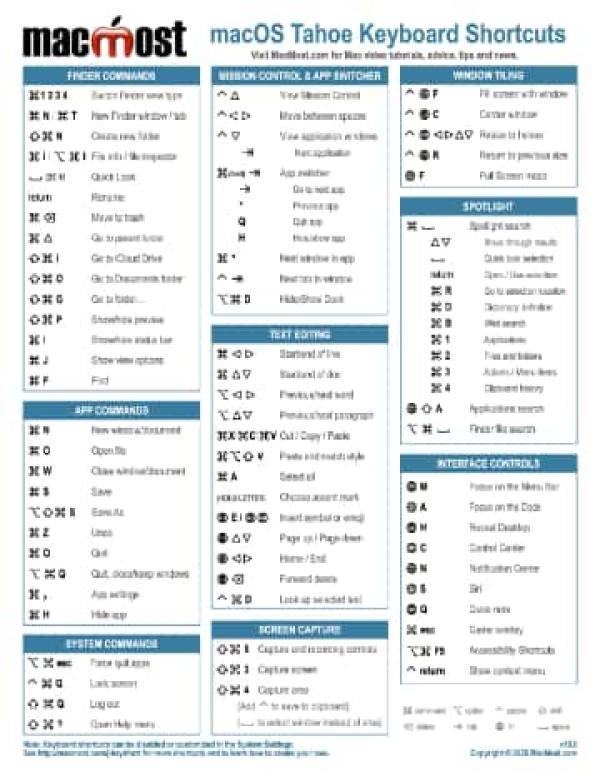
Learn how to find handy keyboard shortcuts by simply looking in the menu at the top of the screen. Also look in System Preferences for more shortcuts. You can change the shortcut used by many system functions. You can also create your own custom keyboard shortcuts. Download and print out MacMost's handy keyboard shortcut guide at http://macmost.com/j-keyshort.

1/8/14
You can use iMovie to create a slideshow video from a series of photos. All of the iMovie tools, like effects, transitions and titles, can be used in a slideshow to make it more interesting than slideshows created in some other tools. You can also easily share your slideshow video from iMovie.

1/6/14
When giving a presentation with Keynote you can use the display on your MacBook to show you more than what the rest of the room sees on the main display. You can see the next slide, the time, and use tools to jump to slides and pause the presentation. You can also view your slide notes.

1/3/14
Learn how to use Pages to create simple page layout documents. You can remove the word processing aspect of a Pages document and place text boxes, images and other elements to create flyers, newsletters, brochures and other types of documents.