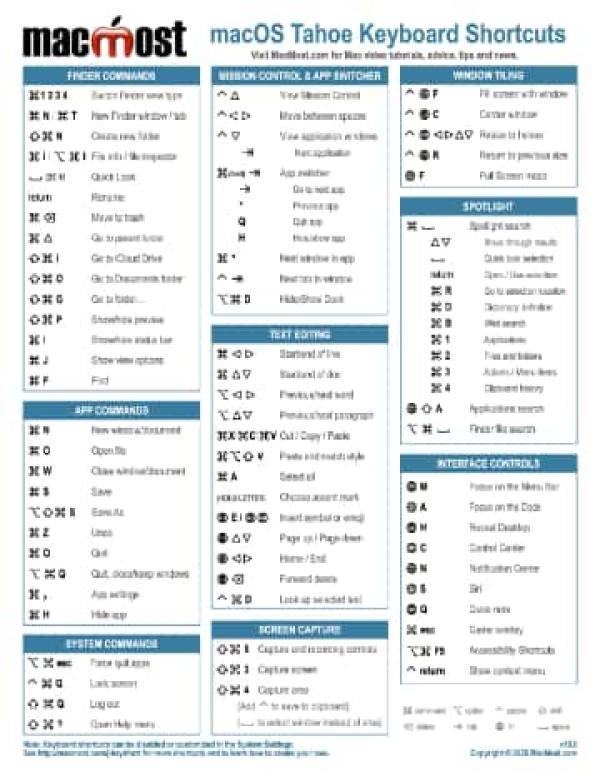
There are hundreds of keyboard shortcuts for Mac users. There are Finder shortcuts, system shortcuts, application shortcuts and more. Many you can find by just looking through the menu bar for that application. You can find system ones by looking in the System Preferences under Keyboard.
But some keyboard shortcuts are more useful than others. And some are harder to remember than others.
So MacMost has compiled a list of our top “power user” keyboard shortcuts. Here they all are on a single PDF page, downloadable and printable: The MacMost Snow Leopard Power User Keyboard Shortcuts. Download it and pass it along!
Two major legal battles in the Apple world wound down this week when AT&T and Verizon seemed to call a ceasefire and Apple scored a key victory over clone maker Psystar.
AT&T sued Verizon over its “map” ads that claim Verizon has more 3G coverage than AT&T. AT&T didn’t like how the maps ignore 2.5G Edge networking and seemed to suggest that no connectivity was available outside of the 3G map areas. Verizon did alter the ads to remove a “Out of touch” label for non-3G areas, but AT&T pressed on. However, this week AT&T dropped the suit, and Verizon dropped its countersuit. Perhaps the two companies decided to spend their money improving their networks rather than paying lawyers?
AT&T has since countered with its own ad spots pointing out iPhone features and the ability of its 3G network to handle data and voice at the same time.
Psystar, who makes PCs that come with Mac OS X installed, settled with Apple in their legal case. Apple got them to stop selling their Mac clones and pay $2.7 million. But Psystar’s lawyers say they will appeal the settlement to a higher court, which could take years. An interesting tidbit came from one report stating that Psystar only sold 768 Mac clones since it started.
More iPhone carrier rumors floated around this week as analysts predicted that perhaps both T-Mobile and Sprint may be able to carry the iPhone next year when AT&T exclusivity runs out. Verizon’s involvement seems less likely now, considering their strong anti-iPhone ad campaign for the Droid phone.
If your mail folders are getting a bit full with old email, you can quickly and easily archive messages into separate files. Select the mailbox folder from the left sidebar in Apple Mail and choose Mailbox, Archive Mailbox. This will create an mbox folder. You can then delete the mailbox folder from Mail. You can always use File, Import Mailboxes to bring the folder back into Mail. You can also open up the created mbox folder to reveal a “mbox” file which you can open in any text editor, even TextEdit, for a quick search of the messages. A good way to use this is to create a new folder, like “Archive 2008” and drag old messages to it. Then archive and delete that folder.
If you play in a neighborhood poker game you could probably benefit from a little practice here and there. Online poker is quite a commitment, but a good iPhone app like Poker Superstars III can provide you with quick little practice sessions to sharpen your strategy. The AI is decent enough to send you packing quickly if you don’t know what you are doing, which will only help to make you a better player.
Which is better, Mac or PC? Why choose? After all, your Mac is a PC, it just runs Mac OS X instead of Windows. And it looks pretty. But what if you need to run an application that is Windows-only? Like a piece of accounting software, an engineering simulation, a database application, or even Internet Explorer to access an IE-only site. But who’s kidding who — we know you probably just want to run a Windows-only game on your Mac.
So there are various options for running Windows software on your Mac. They come in three flavors: virtualization, a Win32 API or rebooting completely into Windows.
A MacMost poll showed that the two virtualization giants were used by most people, with VMware Fusion beating out Parallels in popularity. Both of these run as an application in Mac OS X and create a virtual PC inside your Mac to host the Windows operating system.
They both work extremely well, allowing Windows direct access to the Intel processor in your Mac so it can run at nearly full speed. And since both are several generations past the first version, they can support advanced graphics required for most applications and game, although they are far from perfect.
To use either of these, you would need a full copy of Windows to install. XP, Vista or Windows 7 will work, as well as alternative operating systems like Ubuntu. The application will then create a large file representing the virtual Windows hard drive and walk you though installing Windows on it.
When you launch the program it would boot Windows, giving you the option to view it as a large Window on your Mac, take of over the entire screen, or mix Windows windows with Mac windows. You can even drag and drop and copy and paste between Mac and Windows.
VMware Fusion weighs in at $80 and so does Parallels, although it seems like the actual retail price of Parallels is often cheaper.
Next in popularity is Boot Camp. This is Mac OS X’s ability to allow you to reboot into Windows using a separate Windows partition. The ability to do this is free with Leopard and Snow Leopard, but you still need to provide your own Windows discs. At present, Windows XP and Vista are supported, although Apple promised Windows 7 soon.
The main drawback to Boot Camp is that you need to shut down your Mac and reboot completely. And then do it again when you are done working in Windows and want to return to Mac.
But the main advantage of Boot Camp is the near 100% compatibility. You are essentially running Windows on a PC when you reboot. The only loose ends are drivers for Apple hardware like mice and keyboards and right button clicks when using MacBooks. But these have mostly been ironed out.
Next down on the list was VirtualBox. Another virtualization application. While not as feature rich as VMWare Fusion or Parallels, it has a better price point: free. You’ll still need to install your own copy of Windows, however.
A few people reported using CrossOver or Darwine. These solutions allow you to run Windows applications without having Windows installed. They contain versions of the parts of Windows that applications rely on to run, so they can run in Mac OS X with that help.
The drawback is that few Windows applications are supported. Application support almost has to be added one-at-a-time, meaning that it is only a viable solution if your application happens to be on the list. And many of those applications are already available in regular Mac versions, so running them with a Win32 API application isn’t very valuable.
Thanks to everyone who voted in the poll here at MacMost.com. We’ve now got a good picture of how people run Windows on their Mac. I should point out that there were also quite a few messages along the lines of “I don’t run Windows at all — that’s why I bought a Mac!”
Here are the complete results of the original poll:
Since Apple switched to Intel processors for Macs, it has become much easier to run Windows applications on your Mac. You can use a virtualization application like Parallels, VMware Fusion or VirtualBox to run Windows while still in Mac OS X. You can reboot into Windows with Boot Camp, and you can run a custom implementation of the Win32 API like with Darwine and CrossOver.
Which is your preferred way to run Windows applications on your Mac?
- VMware Fusion (32%, 61 Votes)
- Parallels (29%, 54 Votes)
- Boot Camp (22%, 42 Votes)
- VirtualBox (13%, 24 Votes)
- CrossOver (4%, 7 Votes)
- Darwine (1%, 2 Votes)
- Q (kju) (0%, 0 Votes)
Total Voters: 189
The new MacMost iPhone and iPod Touch app gives users easily access video tutorials, news, recommendations and other content from the Apple tutorial site MacMost.com.
The free app allows users to view recent episodes of the MacMost Now video podcast right inside the app, without downloading the podcast or using the Web browser. New videos come out several times per week and teach Mac, iPhone and iPod users how to get the most from Apple technology.
Gary Rosenzweig, the producer and host of the MacMost video podcast created the app as an alternative to browsing the site with the iPhone’s Safari Web browser. “I’ve found that some people like to access information from apps rather than the Web, so I thought I’d create an app to accommodate them,” said Rosenzweig.
In addition to the videos, the app also displays a weekly Apple news round-up, syndicated news and rumors summaries, a collection of Web-based games from MacMost, recommendations for other iPhone apps, and the MacAnswers daily audio podcast.
“Because the app draws from content on the Web site, we can continue to expand the app to show more information,” said Rosenzweig.
The MacMost iPhone app is available for free from the iTunes App Store and can be downloaded via iTunes on a Mac or PC or directly on an iPhone or iPod Touch.
You can get the app by going following this link to the iTunes App Store.
Links to some of the items mentioned:
An interesting study by NPD Group shows that Mac desktops counted for about 48% of all desktop retail sales in October. While it may seem that it means half of all computers sold were Macs, some of this can be explained by the fact that Macs are more expensive on average, and don’t have a model that is the equivalent of the low-end PC. It is revenue, not units. But this is a recent record for Apple and it does show that they continue to gain market share.
This increase may continue in November thanks to the new iMacs and a Black Friday sale to be announced by Apple on Friday morning.
Minim is one of those rare cases where you find a relatively new game concept in an iPhone game. This 3D puzzle shows you molecules made up of number atoms. You need to combine the atoms following a set of rules until you compress the entire molecule into a single atom. It starts of very easy, but soon the level of complexity makes it challenging as each level gets more difficult.
If you have a folder of files that you think you may not need anymore, but don’t want to delete just in case, then why not compress them into a single file? You can do this very easily by just selecting the folder, Right+Click or Ctrl+Click it, then select Compress. This will create a single .zip file from the folder and all of its contents. You can then throw away the original. You can always double-click on the .zip file to expand it again and get to the files inside. A single compressed file is not only easier to handle, but can save a significant amount of disk space.

Main Ringtones Page
Ringtones Copyright 2008 CleverMedia. These ringtones were created by MacMost (CleverMedia) and may be used for free by anyone. However, they may not be redistributed in any way, free or otherwise. Please direct others to this site where they can download the ringtones for free.

Main Ringtones Page
Ringtones Copyright 2008 CleverMedia. These ringtones were created by MacMost (CleverMedia) and may be used for free by anyone. However, they may not be redistributed in any way, free or otherwise. Please direct others to this site where they can download the ringtones for free.